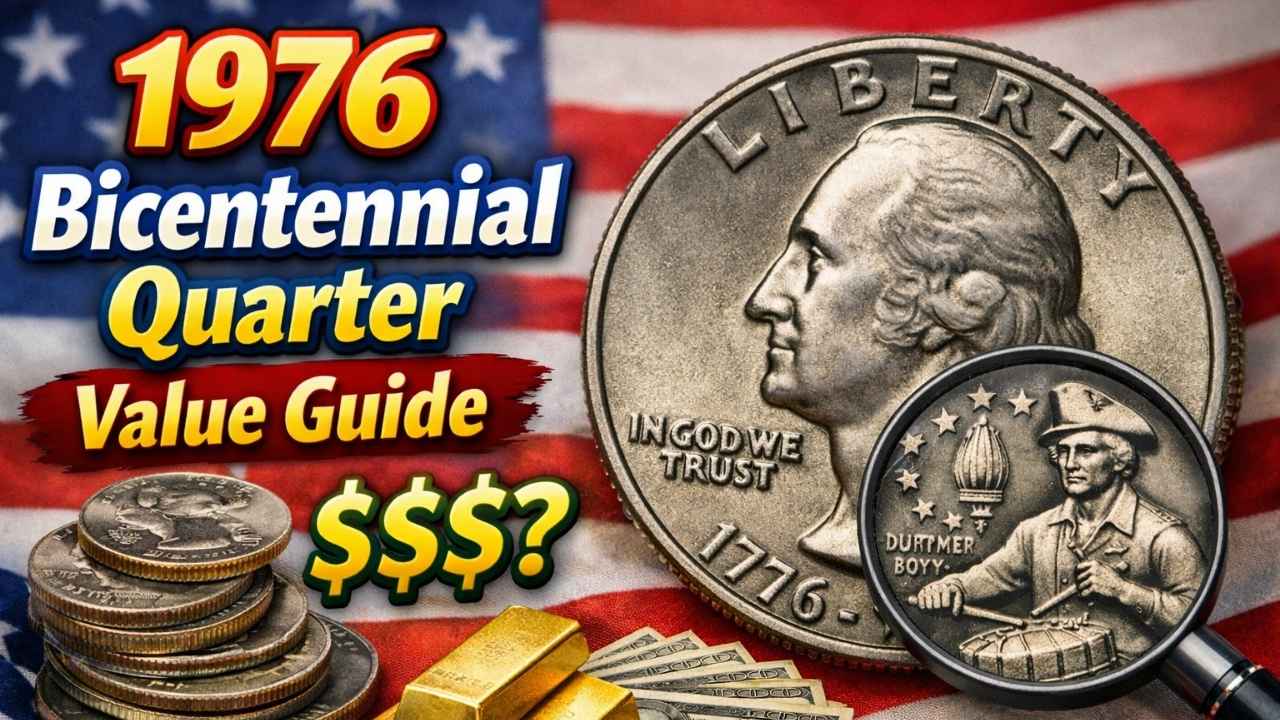
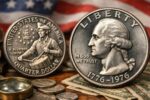
1976 Bicentennial Quarter Value Guide 2026: The 1976 Bicentennial Quarter is one of the most recognizable coins in American history. With its unique reverse design featuring a Colonial drummer and the dual date 1776 to 1976, this quarter was created to celebrate the 200th anniversary of American independence. Millions of Americans saved these coins as patriotic keepsakes, believing they would one day become valuable collectibles.
Now in 2026, fifty years after their release, many people are once again asking an important question. How much is a 1976 Bicentennial Quarter really worth?

While most Bicentennial Quarters remain worth face value, certain rare errors, silver versions, and high grade examples can command impressive prices. In this complete value guide, you will learn about the history of the coin, different types that were minted, rare varieties to look for, grading impact, and updated collector prices.
The History Behind the 1976 Bicentennial Quarter
In the early 1970s, the United States Mint began planning special coin designs to commemorate the nation’s 200th birthday. Instead of issuing coins dated 1975, the Mint produced quarters, half dollars, and dollars with the dual date 1776 to 1976.
The reverse design of the quarter was created by Jack L. Ahr. It features a Colonial drummer boy with a victory torch encircled by thirteen stars, representing the original colonies. The obverse retained the familiar portrait of George Washington.
Production began in 1975 and continued through 1976, but all coins carried the dual anniversary date. This makes it impossible to find a quarter dated 1975.
Because these coins were heavily promoted and widely saved, billions were struck. However, within this large production run, important variations exist.
Types of 1976 Bicentennial Quarters
There were two main compositions produced for circulation and collectors.
| Type | Composition | Mint Marks | Notes |
|---|---|---|---|
| Clad | Copper nickel | No mint mark, D, S | Regular circulation issue |
| Silver | 40 percent silver | S mint mark | Sold in special collector sets |
Clad coins were minted in Philadelphia and Denver for general circulation. San Francisco also produced clad proof coins for collectors.
The 40 percent silver quarters were never released into circulation. They were sold in special Bicentennial sets and are distinguishable by their silver content and S mint mark.
Silver versions naturally carry higher base value due to precious metal content.
Standard 1976 Bicentennial Quarter Values in 2026
Most circulated clad Bicentennial Quarters are worth only 25 cents. However, condition plays a major role in collector value.

| Condition | Clad Value Range | Silver Value Range |
|---|---|---|
| Circulated | $0.25 to $0.50 | $5 to $8 |
| Uncirculated MS 63 | $2 to $5 | $8 to $15 |
| Uncirculated MS 65 | $10 to $25 | $20 to $40 |
| MS 67 and Higher | $500 to $5,000+ | $1,000 to $10,000+ |
Coins graded at MS 67 or higher are difficult to find because many were poorly struck or heavily handled. Registry collectors compete fiercely for top population coins, pushing prices dramatically higher.
Rare Errors That Increase Bicentennial Quarter Value
While ordinary examples are common, error coins can be highly valuable. Mint mistakes are often accidental and produced in small numbers, making them desirable among collectors.
Here are some of the most sought after error types.
| Error Type | Description | Estimated Value |
|---|---|---|
| Doubled Die Obverse | Visible doubling on lettering or date | $300 to $3,000+ |
| Off Center Strike | Design struck off center | $100 to $2,500+ |
| Clipped Planchet | Portion of coin missing | $200 to $1,500+ |
| Struck on Wrong Planchet | Minted on incorrect metal blank | $5,000 to $25,000+ |
| Die Crack or Cud | Raised line or blob from die damage | $100 to $1,000+ |
One of the most exciting discoveries involves Bicentennial Quarters struck on wrong planchets, such as dime or nickel blanks. These dramatic errors can command thousands of dollars depending on condition and authentication.
Doubled die errors are especially popular because the doubling can often be seen without magnification.
Silver Bicentennial Quarters in Detail
The 40 percent silver Bicentennial Quarters were produced specifically for collectors. They were included in special proof and uncirculated sets sold by the Mint.
These coins have several identifying characteristics.
They weigh slightly more than clad versions.
They have a solid silver edge instead of a copper stripe.
They carry the S mint mark.
Silver content provides intrinsic value based on current precious metal prices. In 2026, fluctuations in silver prices continue to influence their baseline worth.
High grade silver proof quarters with deep cameo contrast can reach impressive prices, especially when graded at PR 69 or PR 70.
The Role of Coin Grading in 2026 Prices
Professional grading has become essential in determining accurate coin value. Coins are graded on a 1 to 70 scale, with 70 representing a perfect coin with no visible imperfections under magnification.
Here is how grading affects value.
| Grade Level | Description | Value Impact |
|---|---|---|
| Circulated | Shows wear | Minimal premium |
| MS 60 to 64 | Basic uncirculated | Moderate value |
| MS 65 to 66 | Choice uncirculated | Strong premium |
| MS 67 | Superb gem | Significant jump in price |
| MS 68 and above | Extremely rare | Record setting potential |
Very few Bicentennial Quarters reach MS 68 or higher. When they do, competitive bidding among collectors can push prices into the thousands.
Proof coins graded PR 70 are also highly desirable due to their flawless surfaces.
How to Identify a Valuable 1976 Bicentennial Quarter
If you want to check your quarters, follow these steps carefully.
First, examine the edge. A copper stripe indicates a clad coin, while a solid silver edge may signal a silver version.
Second, check the mint mark. Look below Washington’s portrait for D or S. Philadelphia coins have no mint mark.
Third, inspect the coin under bright lighting. Search for doubling in the lettering, unusual strike patterns, or surface anomalies.
Fourth, weigh the coin if possible. Silver versions weigh slightly more than clad examples.
Finally, avoid cleaning the coin. Cleaning reduces value significantly. If you suspect you have a rare error or high grade piece, consult a professional grading service.
Why Bicentennial Quarters Remain Popular in 2026
The Bicentennial Quarter holds a special place in American culture. It represents a milestone celebration of independence and was widely collected at the time of release.
Many families saved rolls of these quarters as souvenirs, creating nostalgia that continues today. Younger collectors are rediscovering the coin as part of the growing interest in historical American currency.
Because billions were minted, the thrill comes from searching for exceptional examples or rare errors rather than simply finding the coin itself.
Social media and online marketplaces have increased awareness of rare varieties, leading to renewed excitement around this iconic quarter.
Market Trends and Investment Potential
In 2026, the coin market remains strong, particularly for high grade certified coins. Silver prices also influence demand for silver Bicentennial Quarters.
While common circulated examples are unlikely to become highly valuable, rare errors and top graded coins show steady appreciation over time.
Collectors often focus on assembling complete Bicentennial sets that include clad, silver, proof, and error varieties. Demand for flawless examples continues to grow due to registry set competition.
Patience and careful selection are key for those considering these coins as part of a long term collection strategy.
Final Thoughts
The 1976 Bicentennial Quarter is more than just spare change. It is a symbol of American history and national pride. While most examples remain worth face value, rare errors, silver compositions, and high grade certified coins can command impressive prices in 2026.
Understanding mint marks, composition differences, grading standards, and error types is essential for identifying valuable pieces. Even though billions were produced, standout examples are far scarcer than many people realize.
If you have Bicentennial Quarters stored away in jars or collections, take a closer look. Check the edge, inspect the details, and evaluate the condition. While most will remain simple keepsakes, a rare error or pristine silver proof could be worth far more than twenty five cents.
In coin collecting, knowledge transforms ordinary coins into potential treasures. And sometimes, history is worth holding onto.